
More people across the UK are now choosing PDS1 over DSC1 as their preferred deer stalking qualification. This shift reflects growing awareness around governance, flexibility and food chain compliance, rather than familiarity alone.
As the deer managment sector becomes increasingly professionalised and moves toward more stringent regulation, deer stalkers are increasingly deciding upon a qualification based on independent external oversight.
In practice, PDS1 and DSC1 are the two most widely recognised deer stalking qualifications in the UK, and both are commonly referenced when people search for a deer stalking qualification or deer management qualification. However, the two routes differ significantly in how they are governed and delivered.
The outcome - more candidates now choose PDS1 vs DSC1 because the Proficient Deer Stalking Certificate Level 1 (PDS1) not only offers stronger governance, but also provides integrated Trained Hunter status, flexible delivery, assessor confidence, and a clearer professional progression pathway.
Let break that down…here is why:
Governance is now a deciding factor
One of the most important reasons people are moving towards PDS1 is independent oversight and governance.
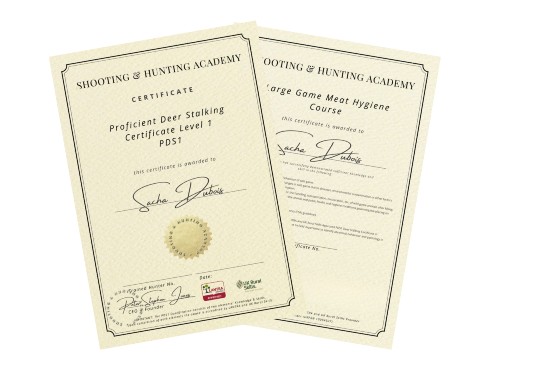 PDS1 (Proficient Deer Stalking Certificate Level 1) is delivered as a LANTRA-accredited award, operating under external quality assurance and audit. LANTRA is an Ofqual-regulated awarding body, with Ofqual being a non-ministerial UK government department. This gives PDS1 a level of independent governance and regulatory credibility that is increasingly valued by candidates, employers, land managers, and regulators.
By contrast, DSC1 (Deer Stalking Certificate Level 1) does not sit within a regulated qualifications framework and does not benefit from third-party accreditation or external awarding body oversight.
For those seeking a future-proof deer stalking qualification, governance is no longer a secondary consideration - it is central.
Trained Hunter status built in
Another major reason candidates choose PDS1 is convenience and completeness.
The PDS1 includes delivery of an Approved Large Game Meat Hygiene course, meaning candidates achieve Trained Hunter status as part of the same qualification pathway.
With DSC1, Trained Hunter status may only be obtained separately through the completion of an additional course.
For many people searching for a UK deer management qualification, the ability to complete both requirements together, rather than piecing together multiple certificates, is a decisive advantage.
Shooting Instructor Craig Hartley said:
“The PDS1 is a great course, and I have to say that I think it is the future when it comes to people needing that base level of knowledge and certification”
A modern delivery model that fits real life
How a deer stalking qualification is delivered matters as much as what it covers.
PDS1 allows candidates to:
- Complete theory online, in their own time
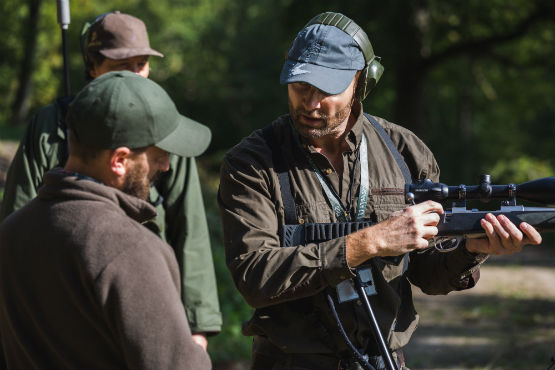
- Undertake practical assessment locally, via an assessor or approved verifier
- Avoid travel, hotel stays, and fixed course dates
This approach suits working professionals, estate staff, and recreational stalkers alike. Candidates are not waiting months for availability, travelling long distances, or incurring unnecessary costs.
Recreational deer stalker Robert Deavall said:
“The entire course was brilliant, easy format, very easy user-friendly platform, and for someone like me, where time is of the essence, it was a great way to get some recognisable qualifications without having to devote best part of a week, travelling staying over in digs and the ensuing expense”
Increasingly, people expect training to fit around their lives and the PDS1 does exactly that.
A more current and comprehensive syllabus
Candidates are also responding to the depth and relevance of the PDS1 syllabus.
PDS1 is comprehensive and up to date, shaped by contributions from multiple industry specialists and stakeholders across deer management, food chain compliance, welfare, and land-based training. It reflects modern best practice, not legacy assumptions.
This makes PDS1 particularly attractive to those who want a credible deer management qualification aligned with current industry expectations.
Social media influencer and ambassador for the British Deer Society - Alex Russon said:
“For me the PDS1 was a game changer. It broke everything down in a way that was easy to understand engaging and practical. I genuinely wish I had found it sooner – it would have made my first deer stalk much less overwhelming! The quality of the videos and the step-by-step structure made it an enjoyable learning experience”.
A rapidly growing national assessor network
Another clear indicator of the shift towards PDS1 is the growth of its assessor and Approved Verifier (AV) network.

There are now over 150 assessors and approved verifiers across all regions of the UK supporting the PDS pathway. Notably, many of these assessors are experienced DMQ Assessors and Approved Witnesses who have chosen to support the Academy’s approach.
This migration reflects a broader professional sentiment: assessors increasingly value clear governance, external oversight, and consistent standards, all of which underpin the PDS1 & 2 framework.
In parallel, well-known and respected figures within the deer management sector have publicly supported the PDS1 & PDS2, including Niall Rowantree, Helen Stammers, Chris Dalton, Peter S Jones, Mike Allison, Oliver Smith, alongside many others at regional and local level. Their involvement reinforces the view that PDS is no longer just an alternative, it has become the mainstream, professionally credible route.
Professional stalker and CEO of Jelen PWS Mike Allison said:
“From what I can see the PDS1 is set to become the British standard in Deer Stalker Training”
Delivered by a sector-leading training provider
PDS1 is delivered by The Shooting & Hunting Academy, a UK Registered Learning Provider and one of the most active and forward-thinking training organisations in the deer management and land-based sector.
The S&H Academy also delivers the PDS2 and Deer Management Certificate Level 3 (DMC3), along with a host of other industry related awards and courses, placing PDS1 within a clear, structured professional progression pathway, rather than as a standalone certificate.
For many candidates, this continuity and leadership, along with first-class customer service is a key reason for choosing PDS1 as their entry-level deer stalking qualification.
PDS1 Candidate Christopher Powell said:
“Correspondence with the Shooting & Hunting Academy was very good and when contacted, they were very knowledgeable and answered my query, leaving me feeling positive about carrying on with the course”
Why this trend is accelerating
Taken together, more people are choosing PDS1 over DSC1 because it offers:
- Stronger external governance through LANTRA and Ofqual oversight
- Integrated Trained Hunter status
- Flexible, cost-effective delivery
- A current, industry-led syllabus
- A nationwide assessor network with growing professional confidence
- A clear route into higher-level deer management qualifications
DSC1 remains familiar, but familiarity alone is no longer enough.
CEO of the Shooting & Hunting Academy Peter S Jones said: “Over the last few years we have seen a surge in demand for the PDS1, driven by the governance and convenience of the PDS1, coupled with the Natural environment (Scotland) Bill which has highlighted the Scottish governments intention to make deer stalking qualifications mandatory”.
As expectations continue to rise around standards, assurance, and accountability, PDS1 is increasingly viewed as the smarter, more robust, and more future-ready deer stalking qualification in the UK.
To find out more about the PDS1 and to enrol, follow this link: Proficient Deer Stalking Course - PDS1
To find out more about the Naturakl Environment (Scotland) Bill follow this link: DSC1 vs PDS1: Scotland’s Deer Management Qualifications and the Natural Environment (Scotland) Bill
*Estimates are derived from provider-level delivery data, observed patterns of course demand, and sectoral evidence. No centrally published UK-wide statistics exist that directly compare annual completion rates for PDS1 and DSC1; accordingly, comparative figures and opinion should be interpreted as informed estimates rather than audited national totals.