
The Food Standards Agency (FSA) and Food Standards Scotland (FSS) consider practical training vital to developing future trained hunters. So why can some candidates now obtain Trained Person status through a route that does not require them to examine a deer carcass?
That is the question at the heart of a growing discussion about training standards in deer stalking, following changes to the Deer Management Qualifications (DMQ) route to Trained Person status.
The FSA/FSS response to an enquiry from the 'Shooting & Hunting Academy' provides an important insight into the regulators’ position and raises serious questions about DMQ decision making and the role practical experience should play in preparing new hunters for their responsibilities.
What has changed?
Under DMQ’s new published Trained Person route, eligible candidates can obtain the status after simply completing DSC1, watching an approved instructional video covering carcass inspection and making a declaration. A physical carcass examination is no longer required as part of that process. Indeed, to become a ‘trained hunter’ through DMQ a hunter need not have even physically seen a deer!
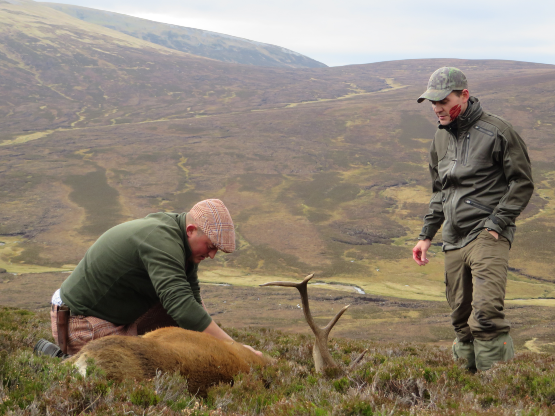
This is a significant distinction. Watching an instructional video can introduce the principles of carcass inspection, but it is not the same as handling and examining a carcass in the field.
For candidates considering their training options, the practical content of a qualification is therefore worth examining alongside its title and the status it provides.
What did the FSA and FSS say?
In a response dated 8 September 2026, Rob Tindall, Head of Operational Delivery at the Food Standards Agency, explained the position of the FSA and FSS.
He wrote that the agencies consider practical training to be:
“a vital aspect of the learning and development of future trained hunters”
The FSA and FSS went on to explain that the agencies were asking relevant stakeholders, voluntarily so far, to include practical training in the training standards framework.
The response also confirmed that the FSA/FSS agencies are, working towards a recommendation to make it a required element.
Why this matters for training choices
The FSA and FSS have made their position clear: practical training is “a vital aspect of the learning and development of future trained hunters”. They are working towards making it a required element of the training standards framework.
That position lends considerable weight to the approach taken by the UK's other leading provider of deer stalker training - the 'Shooting & Hunting Academy' through its 'Proficient Deer Stalking Certificate Level 1 (PDS1), which retains practical carcass examination as part of the course.
While the FSA/FSS process has not yet resulted in a mandatory requirement, their stated view raises an important question for prospective candidates who are seeking a deer stalking qualification in Scotland and England & Wales: if the food safety authorities consider practical experience vital to developing future trained hunters, why choose a training route that does not require a physical carcass examination?
For those who value hands-on experience as part of their preparation for the responsibilities of deer stalking and wish to future proof their qualification, PDS1 offers a clear and relevant option.
But the issue extends beyond the acquisition of a qualification. Carcass examination has direct relevance to hunter competence, food safety during dressing and examination, and confidence in wild game meat entering the food chain, the very considerations identified by the FSA/FSS.
Candidates who want practical experience built into their training should therefore look carefully at what their chosen course actually requires them to do, rather than assuming that all routes provide the same experience.
What happens next?
The FSA/FSS intend to consult stakeholders on the impact and practicalities of making practical training a required element. They also plan to reconvene a stakeholder engagement meeting when the consultation timetable becomes clearer.
Until that process has concluded, it would be premature to describe practical carcass examination as a new mandatory requirement. But the direction of travel described in the response is significant: the agencies regard practical training as vital and are working towards making it a requirement.
For the deer stalking sector, this is an opportunity to consider what credible training standards should look like and how candidates can be properly prepared for the responsibilities that follow qualification.
County Deer Stalking will follow developments as the consultation progresses. In the meantime, prospective candidates have a practical choice to make: whether to select a route that relies on video instruction and declaration only, or one such as PDS1 that includes physical carcass examination as part of the training.
For more information about the 'Proficient Deer Stalking Certificate Level 1 (PDS1) Follow this link:Proficient Deer Stalking Course - PDS1